Connect trends to the underlying signal
Filter trends by time, speed and measurement point, then locate the associated waveform for further analysis.
 Jianxu Digital JIANXU DIGITAL
DESIGN STUDY / JIANXU DIGITAL
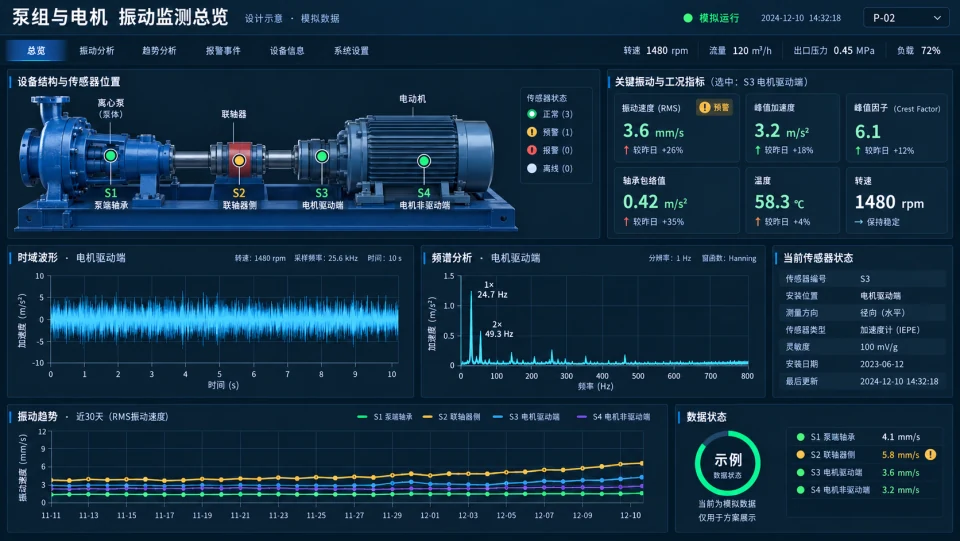
Scenario illustration · Simulated data · No field-delivery claimDrill from station to pump set and bearing point, using speed, flow and pressure to connect an anomalous period to its vibration signal.
THE BUSINESS QUESTION
This pump-scenario design connects points at the pump bearings, coupling side and both motor ends with vibration trends and time-aligned waveforms and spectra. Speed, flow, discharge pressure and load provide operating context. The redrawn illustration uses simulated data and does not establish a deployed pump installation or measured diagnostic accuracy.
ONE WORKFLOW
This is a workflow design illustration. The scope of an operational validation version is agreed after assessment.
DESIGN DECISIONS
Filter trends by time, speed and measurement point, then locate the associated waveform for further analysis.
The design connects acquisition settings, local buffering, online ingestion and offline imports with measurement-point configuration to clarify data sources and continuity.
Spectrum, envelope, order and waterfall views are planned analysis tools. Thresholds, acquisition settings and interpretation criteria depend on the equipment and field conditions.
YOUR FIRST VALIDATION
Choose one measurement point and an authorized anonymized signal set. Validate trend filtering, time alignment, waveform retrieval and recording as one workflow. Identify live data, replayed data and simulations; validate acquisition and diagnostic capabilities against separate acceptance scenarios.
Read the validation and cooperation termsEVIDENCE & BOUNDARIES
Designs do not establish acquisition performance, operating stability or predictive-maintenance benefits. Check integrations, acquisition precision, algorithm performance and alarm handling against field conditions and agreed acceptance criteria.
Public material: Related designs and project notes . Material review and update: . Prepared by the Jianxu Digital technical team.
After requirements assessment and validation and confidentiality agreements, try one operational core workflow before deciding on full development. Agree cost and exit boundaries before work starts.