Services sound comprehensive but remain unclear
Content follows internal departments rather than customer scenarios, questions and decisions.
 Jianxu Digital JIANXU DIGITAL
Website Development · SEO · Lead Generation
For brand upgrades, B2B lead acquisition, international websites and service enquiries. Customer searches and decisions guide content architecture, visual development, SEO, analytics, forms and lead management.
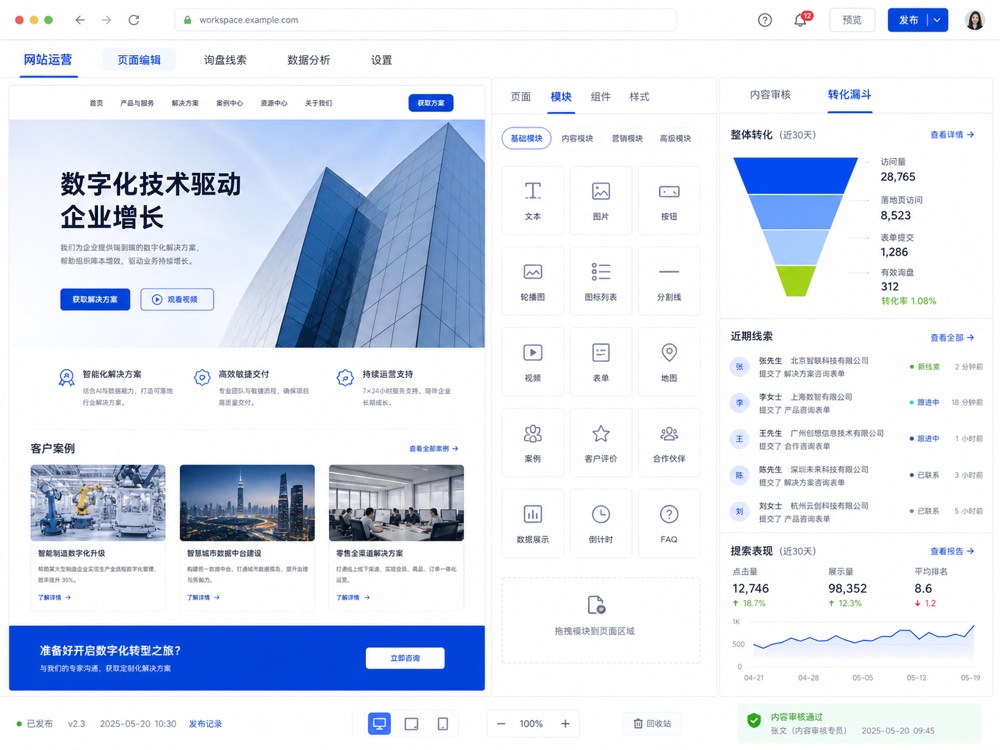
First understand why customers visit, what they need to verify, how trust is built and who follows up after an enquiry.
Content follows internal departments rather than customer scenarios, questions and decisions.
It lacks focused topic pages, semantic headings, structured data, a sitemap and ongoing content paths.
Contact details alone do not provide events, attribution, conversion funnels or a lead console for follow-up.
Without a maintenance approach, pages, metadata and publishing are difficult to sustain.
Choose static generation, server rendering or a CMS according to update frequency, performance and administration needs, keeping complexity purposeful.
Included items follow project scope. The first release prioritizes the most valuable enquiry journey.
Target users, navigation, service descriptions, case structures, FAQs, CTAs and prototypes.
Desktop/mobile layouts, interactions, forms, content maintenance and browser compatibility.
Technical SEO, sitemap, search verification, attribution and conversion funnels.
Production deployment, caching, security headers, source code and maintenance/publishing guides.
Determine whether the website serves branding, acquisition, product information, distributors or customer service before choosing pages, languages, administration and data flows.
Services, industries, cases, trust and enquiry journeys for complex products and professional services.
Focus: Content architecture / SEO / Lead managementOrganize products, applications, downloads and enquiries for international customers, accounting for language and regional differences.
Focus: Language URLs / hreflang / Form attributionManage models, specifications, documents, FAQs, compatibility and product selection.
Focus: Structured content / Search / Download permissionsBuild articles and topics around customer questions to create ongoing search entry points.
Focus: Topic clusters / Editorial workflow / Internal linksLaunch focused conversion pages for products, events, white papers or recruitment.
Focus: One goal / Forms / Channel parametersConnect the website to membership, customer centers, order lookup, service requests or distributor systems.
Focus: Accounts / APIs / Permissions / Status feedbackThis content comes from a delivered project. Client names, production data and some business details are anonymized for confidentiality. Interfaces are redrawn from the actual system structure and do not show raw production data.
With clear content and page scope, a basic sales website can typically reach launch in 1–3 weeks. Multiple languages, complex CMS features, membership or integrations require separate assessment.
Technical SEO supports crawling, understanding and indexing. Rankings also depend on content quality, topic coverage, site history, external signals and ongoing work. We do not promise short-term rankings.
Full development projects deliver source code, deployment configuration and maintenance instructions within the contract scope. Shared components, open-source licenses and third-party services are explained separately.
Yes. We inspect content structure, crawling, performance, CTAs, forms and data flows before choosing targeted improvements or rebuilding.
Share the URL, target customers and desired enquiry types. We will suggest a first phase.
Websites support public information, search visits and enquiries. Mini programs handle services within a platform. Internal systems manage leads, orders and collaboration. They can share APIs without putting every feature on the website.
Present important content as readable HTML, with clear headings, internal links, canonical URLs and sitemaps. Structured data should match visible content. Bounded explanations and case sources help readers and search systems understand answers to specific questions.
Record sources, landing pages, enquiry types and follow-up status, then review impressions, clicks and qualified leads over time. Traffic, rankings and sales are separate metrics; page views alone do not establish acquisition results.