The same customer is maintained in several tools
Sales, projects and finance keep separate lists with inconsistent owners, contracts and payment definitions.
 Jianxu Digital JIANXU DIGITAL
Business System · CRM · ERP · Workflow
For teams whose customers, orders, inventory, projects, approvals and analytics are spread across Excel, WeChat groups or legacy systems. We define master data, state transitions and permissions before building frontends, backends, databases and admin consoles.
When should we build a business system?
Learn more: Fixed-investment launch plan Assess whether you need a system Request a scope assessment
Define one main workflow so statuses and responsibilities become visible.
Sales, projects and finance keep separate lists with inconsistent owners, contracts and payment definitions.
Changes, cancellations, returns and counts lack shared records, creating extensive month-end reconciliation.
Tasks, risks, acceptance and payments do not form a management overview.
Missing APIs, permissions and maintainable documentation force teams to work around the system.
Screens are access points; data models, state machines, permissions, audits and exception handling form the core.
Existing spreadsheets, documents, states, exceptions, responsible roles and initial boundaries.
Key screens, entity relationships, permission matrix, state definitions and integration plan.
Admin console, APIs, tasks, reports, imports, exports and automated tests.
Historical data validation, permission setup, training, backups and operations documentation.
CRM, ERP, WMS and project systems often overlap. Define master data and boundaries around one workflow before naming modules.
Leads, customers, contacts, opportunities, quotes, follow-ups, contracts and payments.
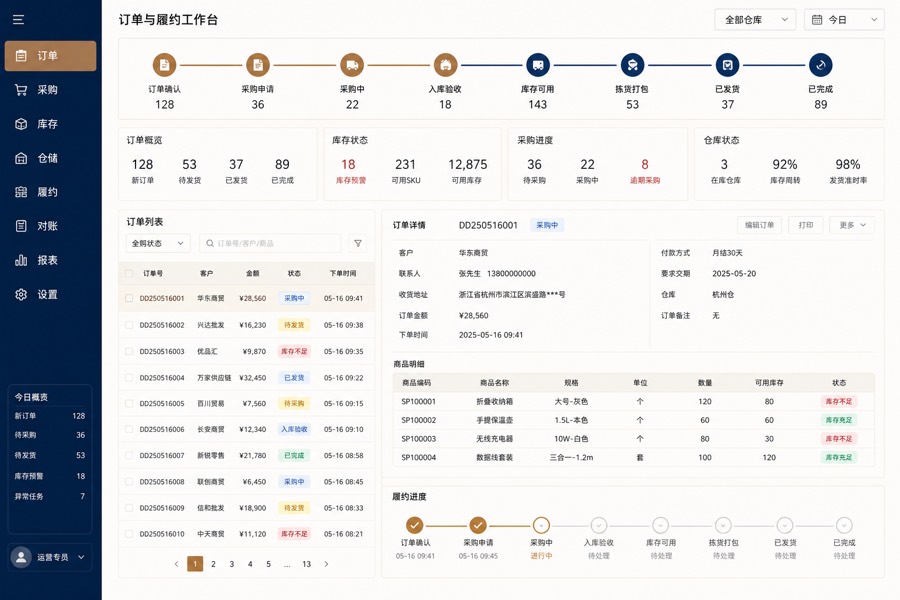
Focus: Ownership / Stages / Reminders / Data permissionsOrdering, review, scheduling, delivery, shipping, receipt, after-sales and reconciliation.
Focus: State machines / Exceptions / Notifications / ReconciliationMaterials, warehouses, locations, batches, serial numbers, scanning, counts and movements.
Focus: Record accuracy / Traceability / Mobile operationsInitiation, contracts, tasks, hours, deliverables, costs, risks and acceptance.
Focus: Cross-team collaboration / Milestones / ResponsibilityApplications, conditions, steps, joint approvals, copies, timeouts, archives and audits.
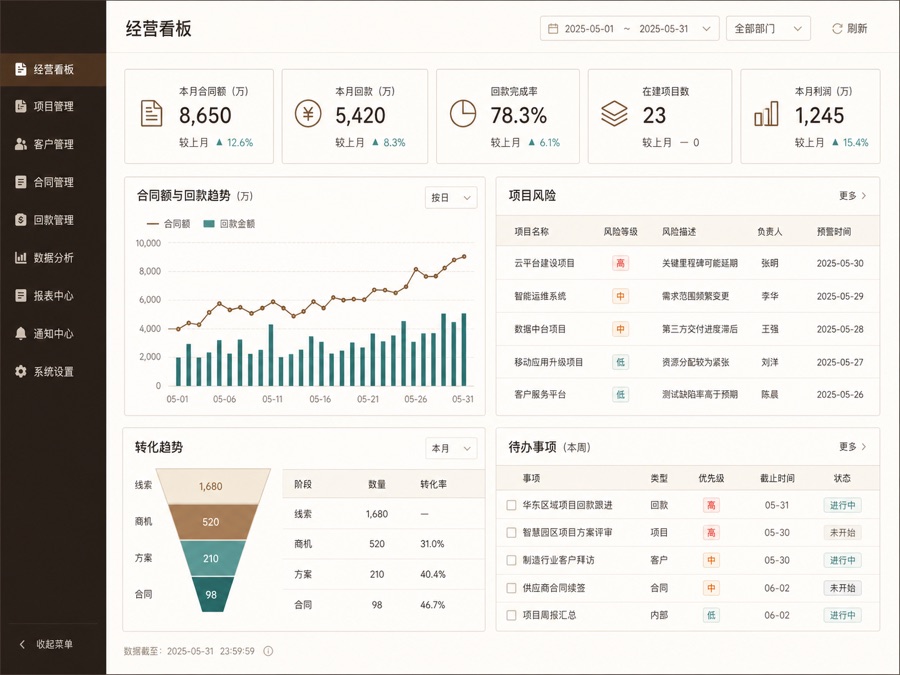
Focus: Rule configuration / Permissions / Activity recordsShared metrics, dashboards, reports, data permissions, imports, exports and exception reminders.
Focus: Definitions / Sources / Updates / TraceabilityThis content comes from a delivered project. Client names, production data and some business details are anonymized for confidentiality. Interfaces are redrawn from the actual system structure and do not show raw production data.
Yes. Existing spreadsheets, documents, conversations, systems and interviews can establish the workflow and scope baseline.
Usually not. Prioritize one valuable workflow such as lead-to-payment or purchase-to-receipt, then expand after validation.
Yes, after checking fields, duplicates, missing values and definitions. Cleaning effort affects timing and pricing.
Yes, where stable APIs, permissions and documentation are available. API limits, sync frequency, failure recovery and reconciliation require separate assessment.
We start with data, states, roles and exceptions before listing features.
Consider it when repeated entry, status checks or reconciliation affect delivery and standard tools cannot support critical rules at reasonable cost. For unvalidated businesses, few users or rapidly changing workflows, begin with existing tools and prototypes.
Choose an input-to-result workflow such as purchase-to-receipt or lead-to-payment, with clear roles, states, data sources and exceptions. Cross-team reports should use shared business objects rather than being built before data definitions are aligned.
Sample duplicates, missing values, definitions and relationships before deciding migration scope. Separate data into migration, read-only archives and deferred cleanup, and reconcile record counts and key totals before and after import.